
B2B Solution Partner for Global Brands
Streetwear production company guide for founders in Germany, the UK, the Netherlands, Poland and Italy: heavyweight fabrics, oversized fits, puff print and embroidery, MOQ for drops, lead times, customs and certification before producing a first collection in Turkey. Written by the FK Textile production team, Istanbul, 2026.
Choosing a streetwear production company is the single most important decision a new label makes. Streetwear is unforgiving: customers know exactly what a 450 GSM hoodie should feel like, they can spot a limp oversized tee from across the room, and they will post about it either way. The factory does not just sew your design, it decides whether the drop feels premium in the hand. This guide explains what a real streetwear production company does, how heavyweight garments are actually built, what MOQ and lead times look like for drop-based brands, and how to judge a streetwear production company in Turkey before you commit to a first run.
Quick Answer: What Does a Streetwear Production Company Actually Do?
The difference between a streetwear production company and a generic clothing factory is not the machines. It is the understanding of weight, drop-shoulder proportions, wash effects and print techniques that streetwear customers expect, and the willingness to work in small, repeatable batches instead of one enormous seasonal order. A factory that mostly produces lightweight fashion basics will struggle with dense loopback, boxy blocks and puff print, no matter how good the price looks.
Streetwear Production Company vs Generic Factory: What Changes on the Garment?
Most founders discover this difference on the first bulk delivery, which is the most expensive place to discover it. Here is what separates a dedicated streetwear production company from a general clothing factory on the finished product.
If you are building a brand around drops, heavyweight fabric and a distinctive silhouette, you need the right-hand column. A streetwear production company in Turkey has become the practical route for European brands because Istanbul’s knit sector has spent decades building heavyweight cotton capability, while staying close enough to Europe for a restock to land in under a week.
Which Fabrics and GSM Does a Streetwear Production Company Use for Premium Drops?
Customers cannot see fabric weight in a product photo, but they judge it within seconds of opening the parcel. GSM, grams per square metre, is the number behind that judgement, and with a true streetwear production company it is your decision, not the factory’s. These are the ranges premium streetwear brands typically specify:
Heavyweight fabric is harder to produce well. It needs the right yarn count, tight-gauge knitting, careful shrinkage control before cutting, and sewing machinery that can handle dense seams without puckering. Garment dye and washes add another layer: a 450 GSM hoodie that is dyed after sewing shrinks and softens differently from a piece-dyed one, and the pattern has to be built with that in mind. A specialist streetwear production company plans these steps before sampling, which is why the finished garment matches the reference instead of surprising you.
How Does a Streetwear Production Company Apply Prints, Embroidery and Washes?
In streetwear, the graphic is often the product. How it is applied decides whether it cracks after five washes or still looks sharp a year later. A capable streetwear production company should offer all of these in-house, and be able to tell you which one suits your artwork:
- Screen print: the standard for bold flat graphics and large front or back prints; water-based or plastisol depending on the hand-feel you want.
- Puff and high-density print: raised, 3D graphics that define a lot of current streetwear; needs precise curing to avoid cracking.
- DTG (direct-to-garment): full-colour, photographic artwork on tight-gauge, enzyme-washed surfaces; ideal for small runs and print-on-demand.
- Embroidery: flat, 3D puff and chenille embroidery for chest logos, sleeve hits and back patches.
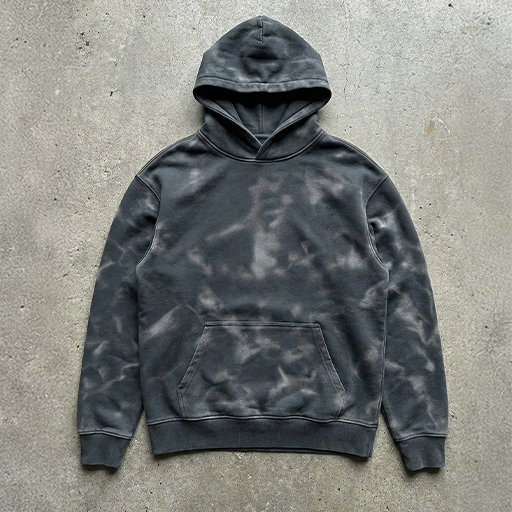
- Garment dye, enzyme and acid wash: vintage, faded and pigment-dyed effects applied after sewing for the worn-in look.
- Branding components: custom woven labels, printed tear-away neck labels, hang tags, branded drawcords, metal tips, zip pulls and packaging.
The important word is in-house. When printing and embroidery are subcontracted, every quality problem becomes a negotiation between two companies while your launch date slips. At FK Textile, print, embroidery and finishing sit inside the same controlled structure as knitting, dyeing and sewing, which is how a streetwear production company keeps unit 500 identical to unit 1.
What MOQ Should a Streetwear Production Company Offer a New Brand?
Streetwear does not sell in seasons. It sells in drops: a limited run, a sell-out, a restock of the winners. A factory that quotes 1,000 pieces per style and colour is not being difficult, it is optimised for volume buyers, but it forces a founder to put five figures into a colourway nobody has bought yet.
Working with a low MOQ streetwear production company changes the economics of the whole brand:
- Launch a first drop at 50 to 100 pieces per style and colour.
- Test three colourways instead of betting the budget on one.
- Create genuine scarcity without faking it, because the run really is limited.
- Keep cash free for content and community, which is what actually sells streetwear.
- Reorder the pieces that sold out while the demand is still live, not two seasons later.
FK Textile is a streetwear production company that supports small-batch and low-MOQ runs specifically because that is how emerging European labels grow. If you are unsure what quantity makes sense for a first drop, tell us your target retail price and launch plan and we will suggest a realistic starting run: request a free sample and quote here.
How Does the Streetwear Production Company Process Work, Step by Step?
Founders are often surprised by how much happens before a single garment is sewn. This is the sequence we run at FK Textile and what each stage asks of you.
1. Consultancy and technical design
We review your references, sketches, mood boards or existing samples and turn them into technical drawings with measurements, tolerances, trims and construction notes. Oversized and drop-shoulder blocks in particular need exact body, sleeve and hem measurements, because “oversized” means something different to every brand. If you have no technical files yet, our tech pack templates walk you through every detail a streetwear production company needs. A measurement corrected in a drawing costs nothing; the same correction after bulk costs a drop.
2. Sampling and approval
We produce a physical prototype, usually within about two weeks, including the print or embroidery so you approve the real thing. You wash it, put it on a fit model and tell us what to change. Most streetwear collections need one or two sample rounds, especially when garment dye or heavy washes are involved. Nothing moves to bulk until you hold an approved, fully branded sample.
3. Bulk production and branding
Bulk runs take roughly five weeks with quality control at every stage: fabric inspection, in-line checks during sewing, print and embroidery inspection, and a final audit before packing. Custom labels, tear-away neck labels, hang tags, drawcords and hardware are applied so the garment carries only your brand.
4. Logistics and delivery
Garments are folded, polybagged, size-labelled and packed to your specification, then shipped through our logistics network with export documentation prepared. Your job at this point is to have a warehouse or fulfilment partner ready for the drop.
How Fast Can a Streetwear Production Company in Turkey Deliver Drops to Europe?
For a drop-based brand, distance is measured in restock speed. A collection leaving Istanbul by road typically reaches Central and Western Europe in under a week, which is what makes the launch-small, restock-fast model possible. Typical door-to-door planning ranges our European clients use:
- Italy and Poland: usually the fastest routes, often 3 to 5 days.
- Germany, Austria and Czechia: commonly 4 to 6 days.
- Netherlands, Belgium and France: commonly 5 to 7 days.
- United Kingdom: usually 6 to 8 days including the crossing and customs clearance.
- Air freight: 1 to 3 days when a launch date cannot move.
On customs: Turkey and the EU operate a customs union covering industrial goods, and apparel falls inside it. With correct documentation, streetwear garments enter Germany, the Netherlands, Poland, Italy and the rest of the union without customs duty. Import VAT is still payable in the destination country through your normal VAT return. UK brands import under the separate UK-Turkey trade agreement, so rules of origin and paperwork differ slightly. A streetwear production company that ships to Europe every week prepares these documents as routine. Confirm current requirements with your forwarder before a first shipment.
Is a Turkish Streetwear Production Company Compliant With EU Sustainability Rules?
Sustainability has moved from a marketing line to a legal requirement. EU ecodesign rules, digital product passports, sustainability reporting and supply chain due diligence obligations are phasing in, and Germany already enforces its own supply chain law. Retailers and marketplaces pass those requirements down to brands, which means to you, even for a five-person streetwear label.
Practically, a European streetwear brand should be able to document:
- Certified materials: GOTS for organic cotton, OEKO-TEX for chemical safety, GRS for recycled content.
- Traceability: where the yarn came from, where it was knitted, dyed, sewn and printed.
- Labour standards: audited working conditions across the chain, not only at the final factory.
- Composition and care data: accurate fibre content for labelling and product passport requirements.
At FK Textile, sustainability is built into sourcing rather than added at the end. We work with GOTS and OEKO-TEX certified materials including organic cotton and recycled blends, and maintain ethical labour standards across the supply chain, with documentation your retail and marketplace partners can review.
Turkey Compared With Other Streetwear Production Company Options
Every sourcing region has a genuine case. The honest comparison for a European streetwear brand looks like this:
If you are producing 20,000 basic tees a year on price alone, the Far East case is real. If you are building a streetwear brand that lives on heavyweight fabric, limited drops and fast restocks, a streetwear production company in Turkey usually wins the arithmetic once you count duty, freight, capital tied up in stock and the cost of missing a sell-out moment.
What Streetwear Production Mistakes Cost Brands the Most?
After working with hundreds of emerging labels, the same expensive errors repeat:
- Approving bulk from photos. A picture cannot show fabric weight, shrinkage after wash or how a boxy block actually sits. Always approve a physical sample.
- Describing fit as “oversized” without measurements. Give body width, sleeve length and hem in centimetres, or the factory will guess.
- Choosing a streetwear production company on unit price alone. The cheapest quote often excludes print, labels, packaging or shipping and reappears as a bigger final invoice.
- Ordering a full size run before validating the base size. Fit problems multiply across sizes. Confirm the base size first.
- Treating labels and packaging as an afterthought. In streetwear these are the components customers photograph and post.
- Working through a broker without knowing the factory. If you cannot name the facility, you cannot answer a retailer’s compliance questions either.
7 Questions to Ask a Streetwear Production Company Before Ordering
Use these questions on any streetwear production company you speak to, including us. The answers say more than a price list does.
- Which stages happen in your own facilities? Knitting, dyeing, sewing, printing and embroidery under one structure means fewer handoffs and fewer surprises.
- Can you show heavyweight streetwear you have made? Ask for 400+ GSM hoodies and oversized blocks, not generic basics.
- What is your MOQ per style and per colour? These are different numbers, and the second one is where drop budgets get destroyed.
- Can I have a physical, printed sample before bulk? The only acceptable answer is yes.
- Which print and finishing techniques are in-house? Puff, screen, DTG, embroidery, garment dye and washes should all be covered.
- Which certifications can you document? Ask for certificate numbers, not logos on a website.
- Who will I actually communicate with? A named contact who answers within a working day is worth more than a small discount.
Beyond Custom Streetwear Drops: Core Apparel and POD Blanks
Not every streetwear project is a designer-led drop. Many brands also need clean, repeatable basics, such as premium blank hoodies, oversized sweatshirts, heavyweight tees and joggers, produced to the same specification month after month as the backbone of the range. That is what our Essential & Core Apparel service is built for.
Print-on-demand and merch labels have a different priority: the blank has to print well. Our POD Manufacturing & Blank Supply service covers DTG-optimised surfaces with enzyme washes and tight-gauge knitting for sharp ink, tear-away labels so you can apply your own neck print, custom GSM and composition, and batch-to-batch colour consistency so the black you order today matches the black you order in six months. For fully designed streetwear collections, our Fashion Brands service takes a concept from tech pack to delivered, fully branded drop, with a streetwear production company handling every stage in between.
Frequently Asked Questions
What does a streetwear production company do?
A streetwear production company manufactures hoodies, oversized t-shirts, sweatpants, shorts and outerwear to your own design, fit and fabric specification, then applies your prints, embroidery, labels and packaging so the finished garment carries only your brand. FK Textile runs the full chain, from knitting and dyeing to cutting, sewing, printing and branding, in Istanbul for streetwear brands across Europe.
What is the minimum order quantity at a streetwear production company in Turkey?
Volume factories often ask for 500 to 1,000 pieces per style. FK Textile supports low-MOQ streetwear production from around 50 to 100 pieces per style and colour, which matches how streetwear brands sell: limited drops, tested colourways and fast restocks.
How long does a streetwear production company in Turkey take to deliver?
Sampling is about two weeks, bulk production about five weeks, and road transit to Central Europe a few days. Most brands plan around a two-month window from approved tech pack to a branded drop in the warehouse, plus buffer for sample revisions.
What GSM should a heavyweight streetwear hoodie be?
Premium streetwear hoodies typically sit between 380 and 500 GSM, heavyweight t-shirts between 220 and 280 GSM, and sweatpants between 320 and 450 GSM. A specialist streetwear production company builds to the GSM you specify rather than steering you to a stock fabric.
Do I pay customs duty importing streetwear from Turkey into the EU?
Apparel falls under the EU-Turkey customs union, so qualifying shipments with correct documentation enter EU member states without customs duty. Import VAT still applies in the destination country. UK imports run under the separate UK-Turkey agreement. Confirm current requirements with your freight forwarder.
Can you do puff print, embroidery and garment dye in-house?
Yes. Screen print, puff and high-density print, DTG, flat and 3D embroidery, garment dye, enzyme and acid washes, plus custom labels, hang tags, drawcords and hardware are all applied in-house, with certified fabrics and batch-to-batch consistency.
Ready to Work With a Streetwear Production Company in Turkey?
Low MOQs, heavyweight certified fabrics, puff print and embroidery in-house, full custom branding and delivery across Europe in days. FK Textile is ready to be your streetwear production partner.
Request a Free Sample